Designed to perfection
We build equipment the way dive plans are written: every dimension justified, every function proven in open water before it earns the logo.
We build equipment the way dive plans are written: every dimension justified, every function proven in open water before it earns the logo.
Products line
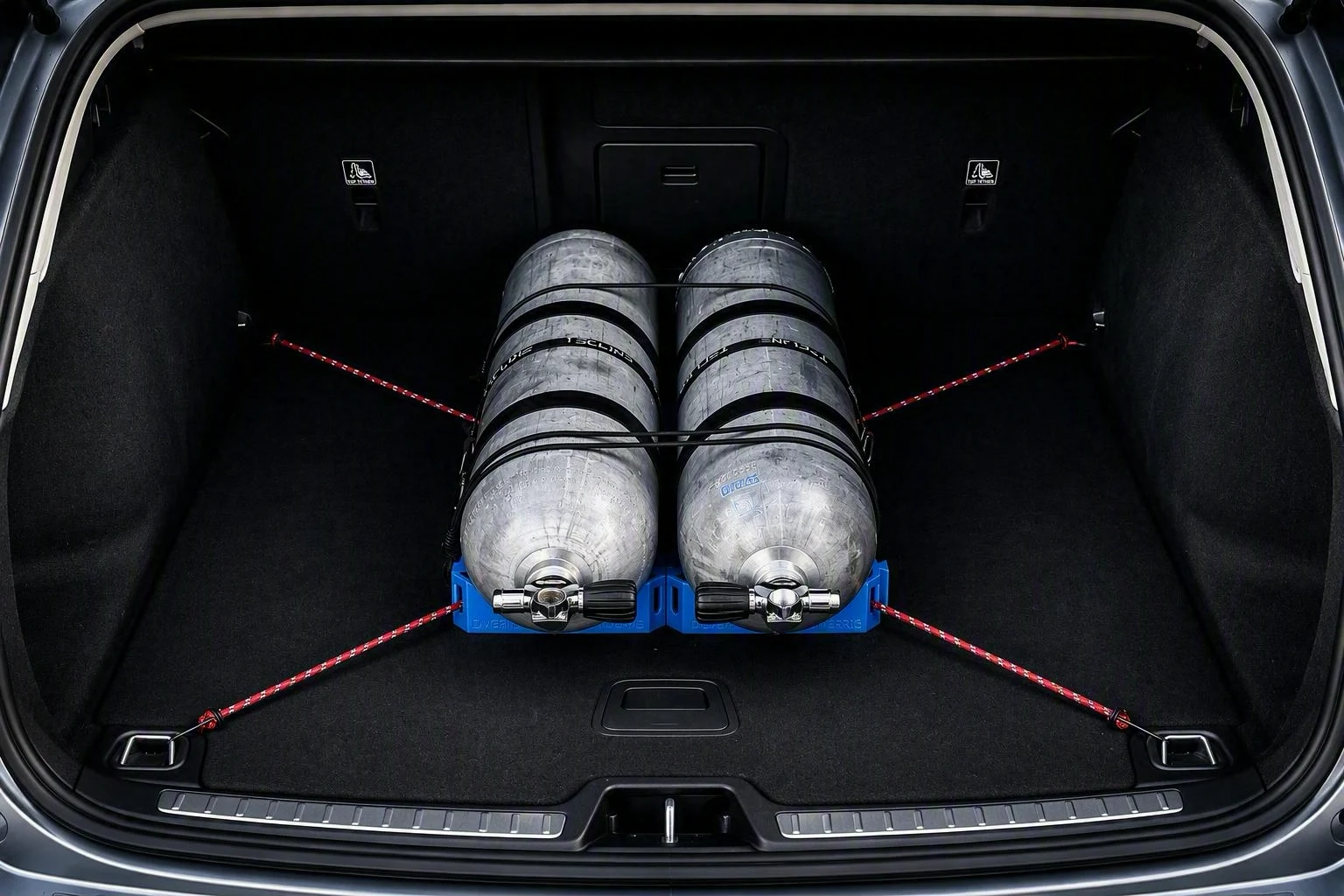
Cylinder transport
One tank, one module — a dovetailed row that grows with your gear. No tools, no hardware, no glue.
View product→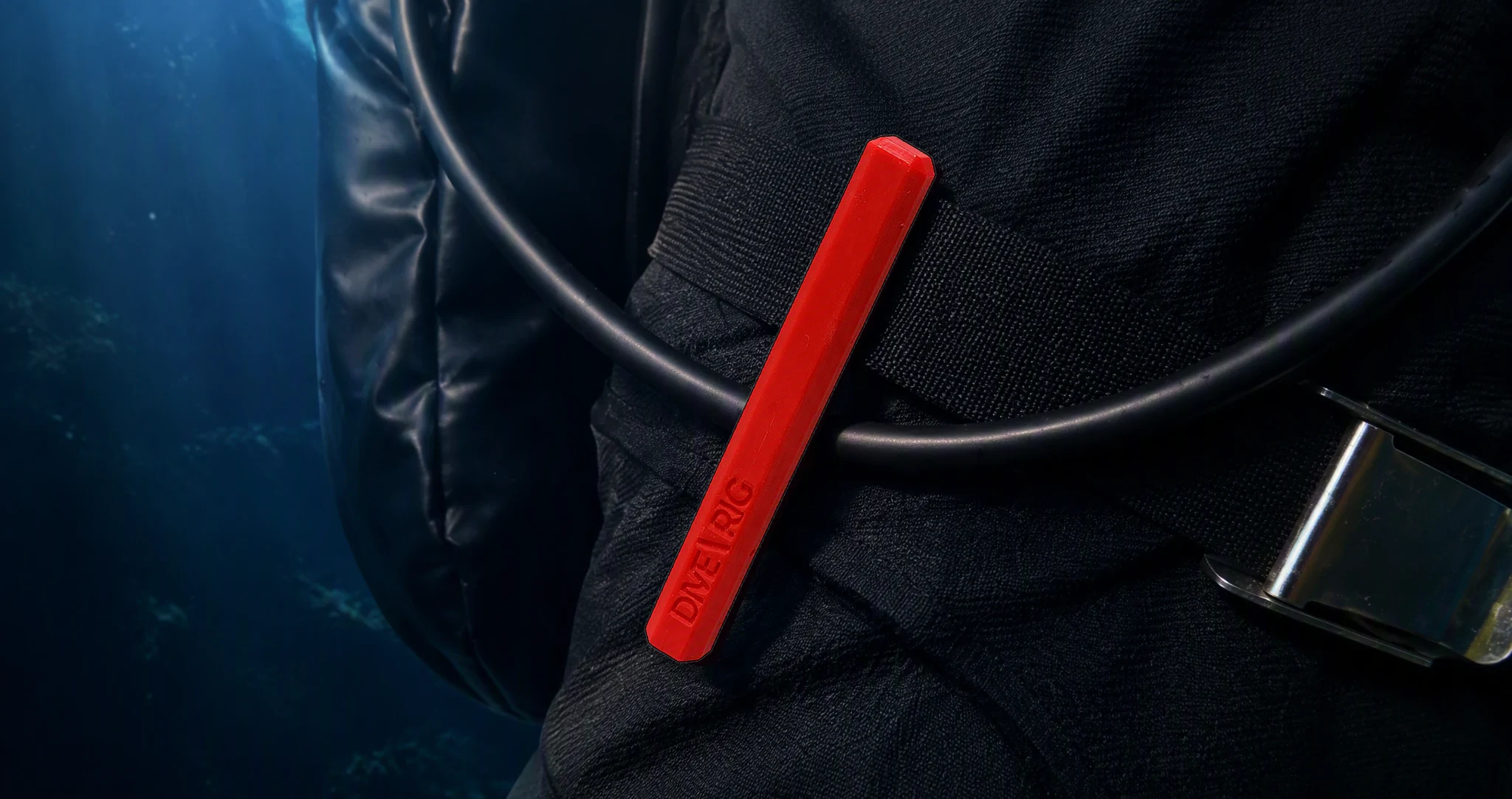
Long hose management
The long hose rides flat on your waist belt — clipped on any 50 mm webbing, stowed in one push, deployed in one pull.
View product→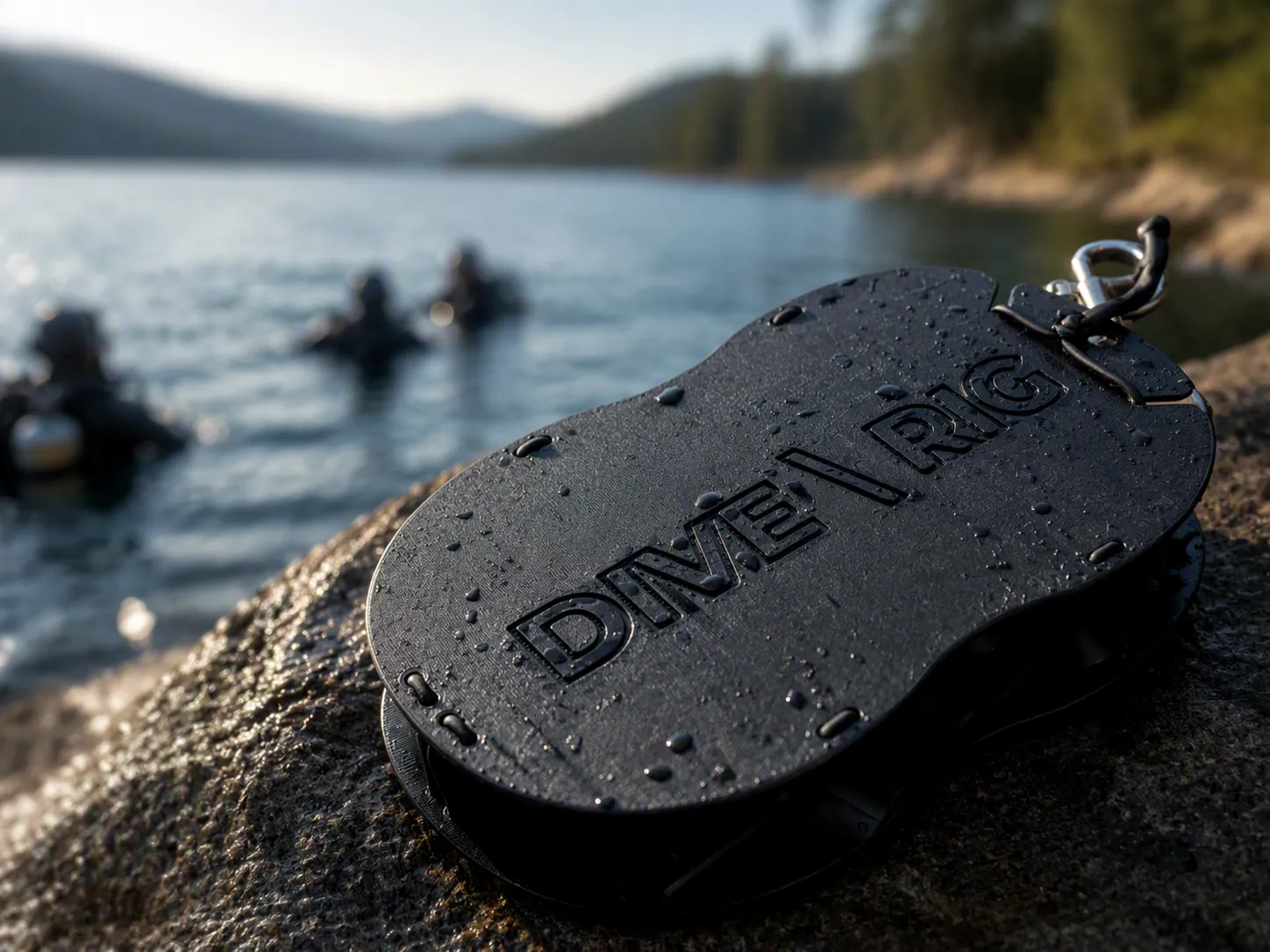
Backup mask dock
Two rigid plates and a bungee cage hold the spare mask flat and protected — no pocket needed, out in one hand without looking.
View product→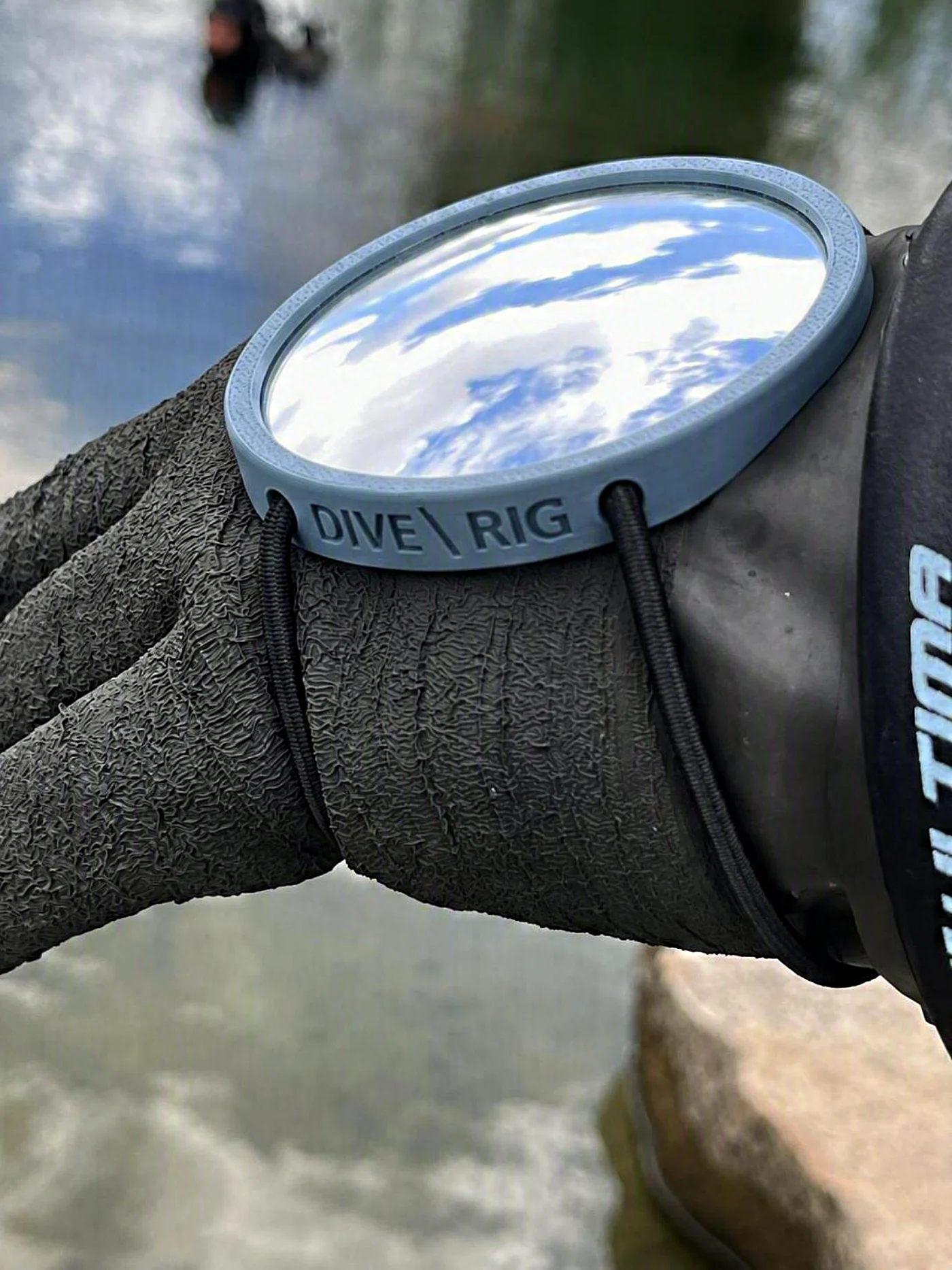
Diver's mirror · Ø 5 / 7.5 / 9.5 cm
Three sizes of one instrument: find your buddy easily, check your own valves or catch the boat's attention.
View product→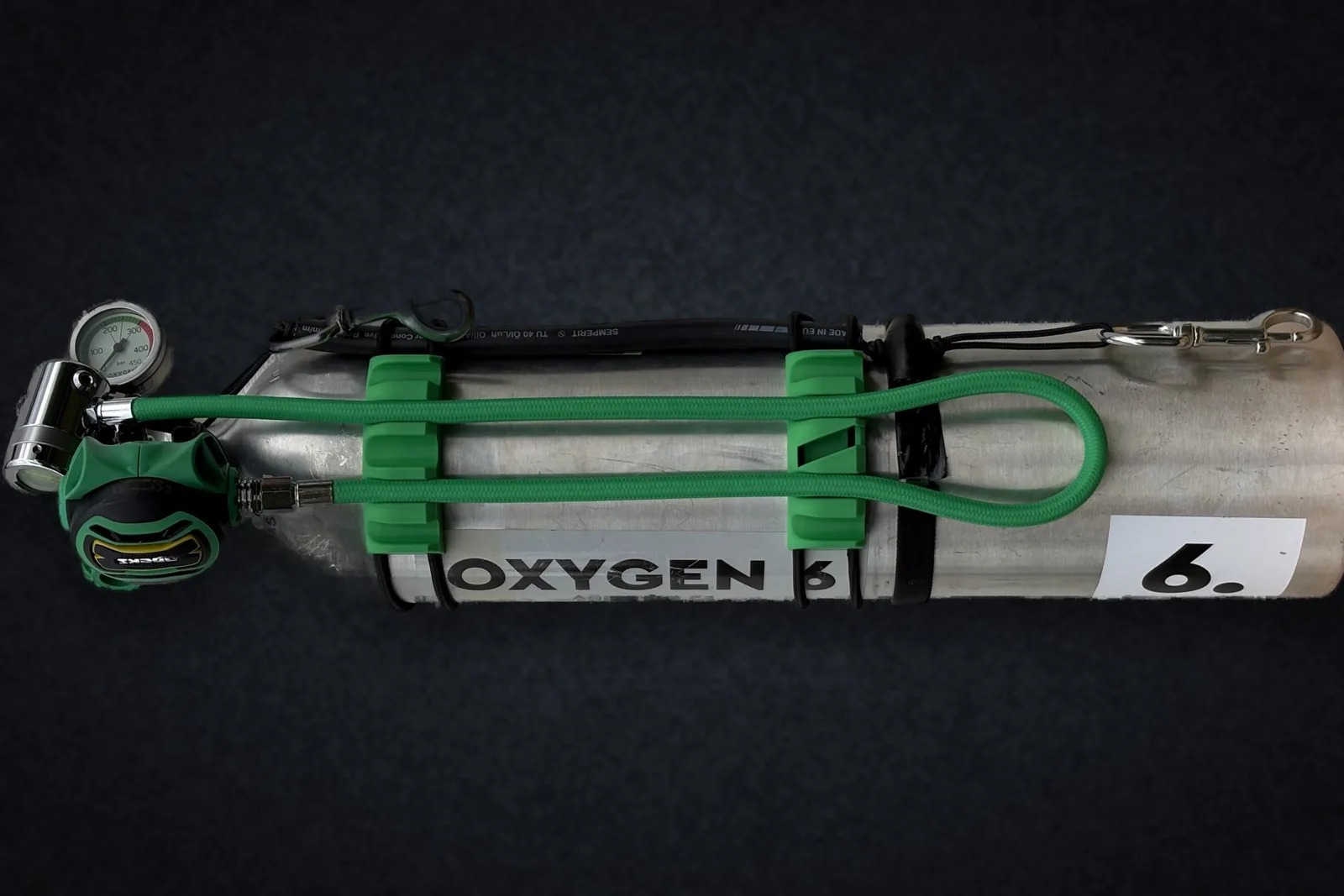
Stage hose management
Four hoses in four channels, flat against the stage cylinder. Printed for your cylinder diameter — backslash, window or SPG-recess centre.
View product→Cave navigation
Arrow, cookie, square cookie, REM — every one with your initials embossed, readable by touch. Printed in your colour.
View product→Line & navigation
Our signature 30 m spool. A wide-ring 30 m you can wind in thick gloves without looking. And a compact 20 m jump spool. Three spools, one grip.
In testingUniversal torch hand mount
Fits the torch you already own. Three bungee loops hold the light, one holds the mount on your hand — in three sizes by torch diameter.
View product→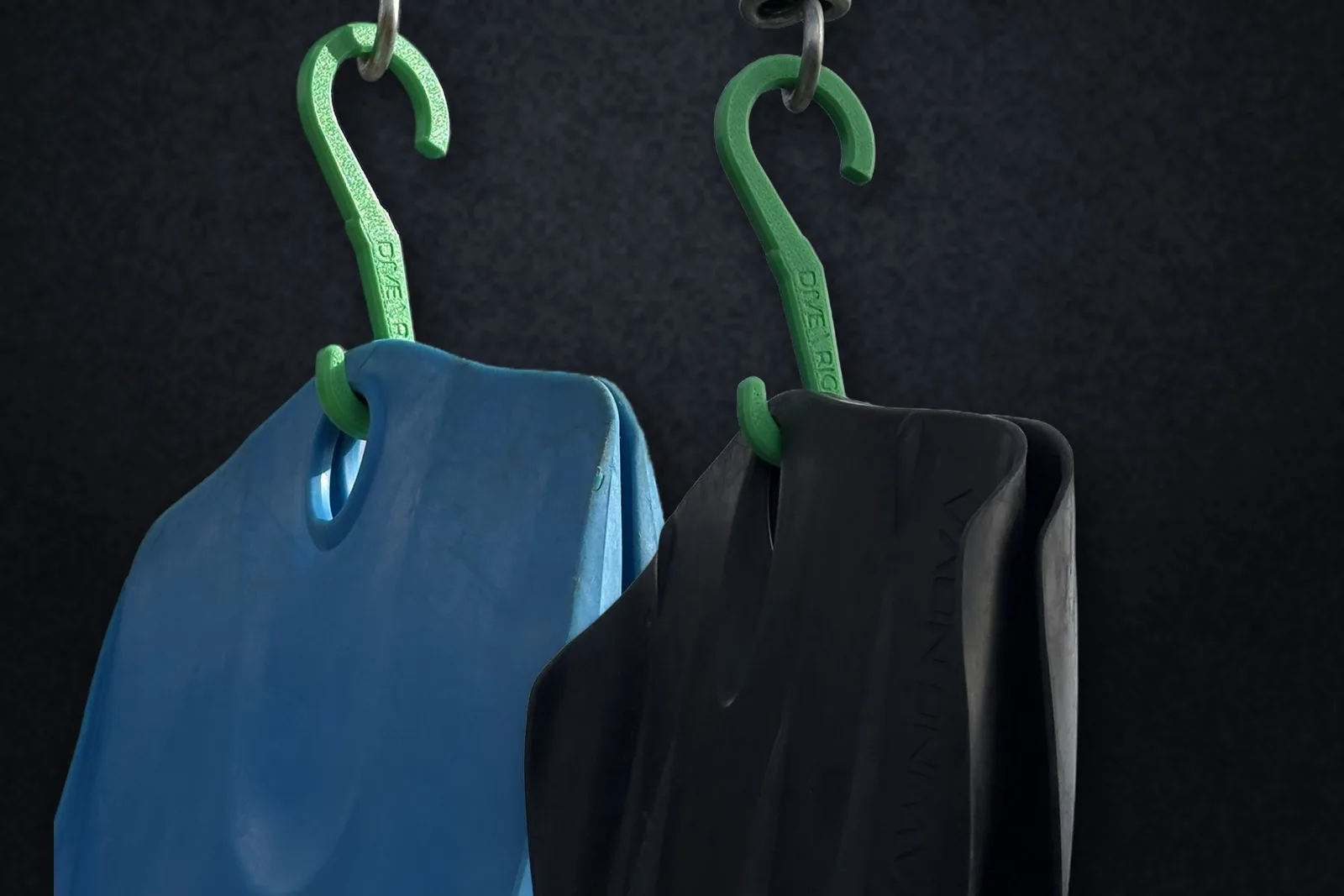
Small parts
DIN caps for cylinder and regulator, colour-coded for status and marked with your initials — plus a fin hook for wall, door, shelf or rod.
View product→Why DIVE\RIG
Three things we don't compromise on. Everything else follows from them.
Nothing here was drawn at a desk and shipped. Every product starts with tec and cave divers and their instructors — people who clip their lives to gear for a living. They shape it, then take it into cold water, silt and overheads and try to break it.
What comes back in one piece gets a name. What doesn't goes back on the bench.
Almost every 3D-printed dive accessory you can buy is standard PETG. It's cheap, it prints easily, and it cracks at a notch when something hits it hard and cold. We weren't willing to settle for that on parts that carry load in the water.
So we work directly with a material producer on a new-generation copolyester: up to twenty times the notched impact strength of PETG, seven times the stretch before it breaks — and it yields instead of shattering. The numbers are below. We'd rather you read them than take our word.
Not everything needs it. Anything that carries load in the water is printed in this polymer. Parts whose whole job happens on dry land — hanging, capping, organising — are printed in a premium PETG with improved UV resistance, because there it is the right material, not a compromise.
| Property | Standard PETG | Delrin / POM | DIVE\RIG polymer |
|---|---|---|---|
| Notched impact strengthIzod · kJ/m² | ≈ 6 | ≈ 9 | 93 |
| Elongation at breakhow far it stretches before it fails · % | ≈ 30 | ≈ 30 | 220 |
| Failure modewhat happens when it finally gives | cracks at the notch | brittle fracture | yields, doesn't shatter |
| Flexural modulusstiffness · MPa | ≈ 2 000 | ≈ 2 800 | 1 600 |
| UV & sunlightdeck, boat, drying rack | fair – good | poor unless stabilised | very good |
| Densityg/cm³ · all of them sink in seawater | 1,27 | 1,42 | 1,23 |
| Typical figures from producers' technical data sheets for filament-grade material, same test methods across the row, rounded. PETG values are averaged towards the low end of the market, because that is what most printed dive gear is made of. POM is stiffer and stronger in pure tension — that is why it's machined into gears and bushings. A spool, a holder or a clip doesn't fail in tension; it fails when it's dropped, stepped on or slammed against a cylinder. That's the impact column. | |||
Nothing here sits in a warehouse. Your colour, your cylinder diameter, your initials — each piece is printed for the order it belongs to, then checked by hand and fitted to real gear before it goes in the box.
If a part ever fails you in the water, we want to hear about it. That's how the next version gets better.
Conditions
If it survives a Czech quarry in February, the Red Sea is a holiday.
Start here
TankLock™ is DiveRig™ in one object: a modular cylinder cradle, dimensioned to the millimetre and proven in the trunk, on the boat and at the bottom of the quarry.
TankLock™ — see the product→